
Just Volleyball Spike Guide: Timing and Aim
How to spike in just volleyball: approach timing, jump height, cursor placement, hitting around the block, and the shot selection that beats a set defence.
A spike is the most satisfying contact in just volleyball and the one that loses the most points. The ball is fast, the block is close, and the cursor has to do two jobs at once: keep the ball in the court and put it where nobody is standing. This guide separates the motion from the decision so you can practice both.
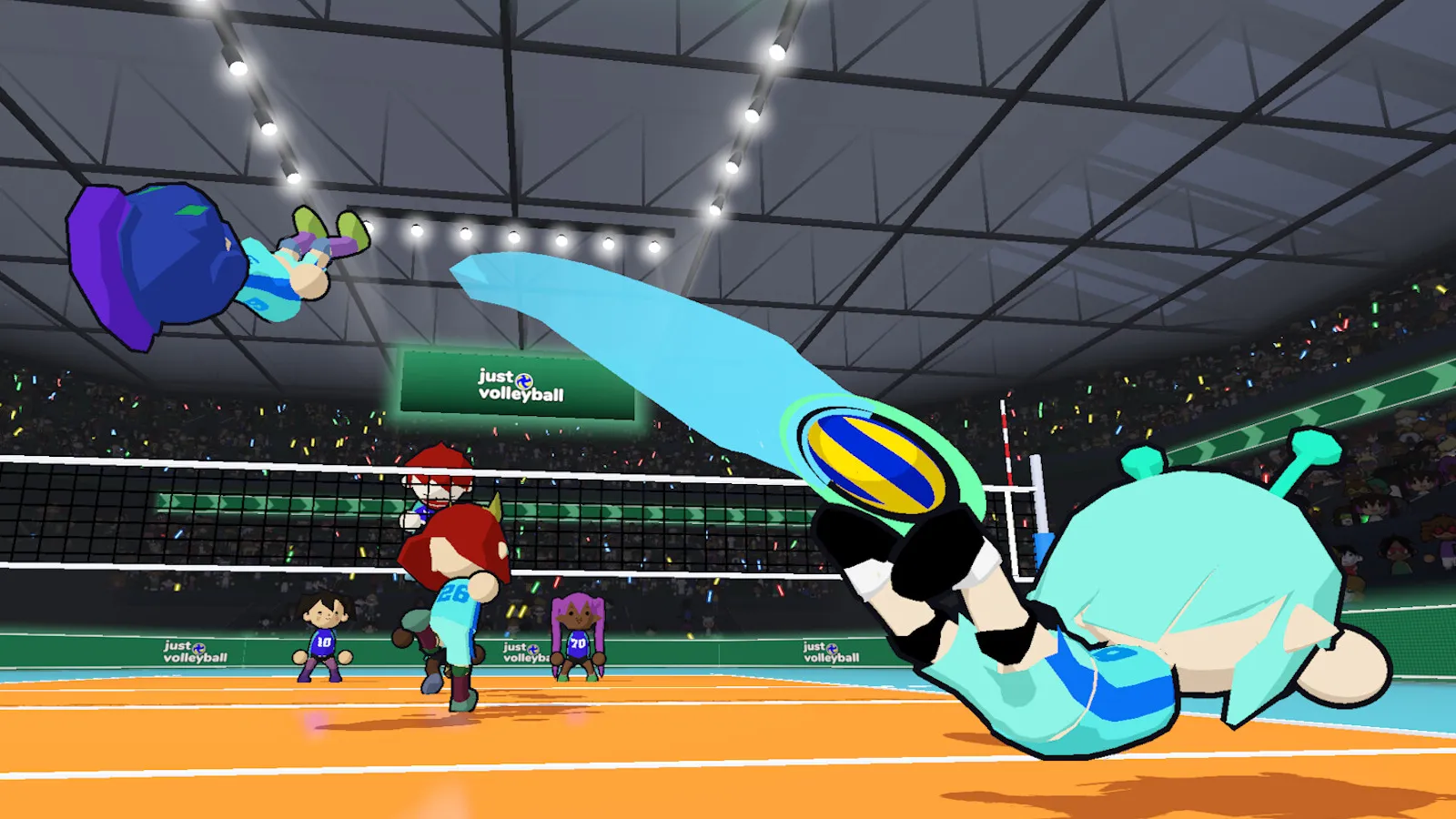
Jump early, meet the ball at the top of your reach, and aim at the floor. Power is the last thing to add, not the first.
The spike motion
A spike has three phases: approach, jump, contact.
Approach
Start a step behind the attack line and move toward the net at an angle. The approach gives you forward momentum, which the game converts into jump height and forward reach. A flat, straight approach is easier to block; an angled approach opens the cross-court shot.
Do not sprint. A sprint overshoots the ball and puts you under the net. A controlled three-step approach is enough.
Jump
Jump with Space. Holding Space charges the jump, which changes the timing and the height. A charged jump is not automatically better: it takes longer, and the ball may pass your contact window while you are still rising.
The practical rule: jump when the setter's ball is about to reach its peak. If you jump after the ball starts falling, you will contact it below the net.
Contact
Left click in the air. The cursor decides the landing spot. Aim at the floor, not at the back wall, and not at a defender's chest. A spike that hits the floor inside the lines is a point even if it is not the hardest hit of the match.
The contact point matters more than the swing speed. A ball met at the top of your reach can be directed; a ball met at shoulder height is a prayer.
Hitting around the block
The block is not an obstacle to overpower. It is a shape to read. Before you jump, look at the blocker's hands and feet:
- Two blockers packed on the line: hit cross-court or use the seam.
- Two blockers spread: hit the seam or the line.
- One blocker late: hit high off the hands and out of bounds.
- One blocker committed early: use a soft shot or a tip.
The best hitters do not decide in the air. They decide before the jump and adjust only if the block moves. A mid-air decision is usually a mistake.
Shot selection
A spike is one option in a family of attacks. The others are often better:
| Shot | When to use | Risk |
|---|---|---|
| Power spike | Hitter has a clean lane and the block is late | High error if the angle is tight |
| Cross-court spike | Block is packed on the line | Can sail wide if the cursor drifts |
| Line spike | Block is cheating cross | Easier to block if they read it |
| High off the hands | Block is set and you cannot hit around it | Needs a high contact point |
| Tip or roll shot | Block is committed, backcourt is open | Slow; a good defender can pick it up |
The soft shot is underused. A tip into the gap between the block and the backcourt is a higher-percentage point than a wild swing at a tight angle.
Common spike errors
Jumping too late. The ball is already falling when you leave the floor. Fix the timing before you fix the power.
Contacting under the ball. You hit the ball upward, and it sails long. Meet the ball in front of your shoulder, not above your head.
Aiming at the defender. The cursor goes to the nearest body instead of the open floor. Pick the gap before the jump.
Hitting into the net. The approach is too close. Start a step farther back and contact the ball slightly in front of the net.
Spiking every ball. Some sets are not hittable. A free ball or a soft return is better than a forced error.
Block interaction
A spike against a block is not a loss if you use the block. Hitting high off the outside hand can send the ball out of bounds for a point. Hitting into the seam can split two blockers. Hitting hard into a solid wall usually gives the opponent a transition.
If the block is early and sealed, do not swing. Tip, roll, or recycle the ball. A live rally is better than a blocked ball.
The receive and positioning guide explains where the defenders stand behind the block, which tells you where the open floor is.
Practice drill: 15 swings
Set up a bot or a friend to set and block. Hit five balls cross-court, five line, and five high off the hands. Count only the swings that either score or force a playable ball.
Then repeat with a live blocker who is allowed to read you. The goal is not to win the drill; it is to make the same swing twice in a row. Consistency is the skill that transfers to a match.
Spike timing with different sets
- High set: wait, then jump as the ball peaks. This is the easiest timing.
- Quick set: jump earlier, before the ball arrives. The setter is setting the space, not the ball.
- Off-the-net set: the ball travels farther, so the approach starts later. Do not drift under the net.
- Tight set: the block is already there. Tip or hit high off the hands.
If the set is bad, the correct play is often a free ball, not a hero swing. The receive and set guide explains how to read a bad set before you commit to the approach. Good attackers are judicious, not just powerful.
The mental side
Spiking is the most emotional contact. A miss feels worse than a bad pass, and the temptation is to swing harder on the next ball. Resist it. The best response to a missed spike is a higher-percentage shot, not a revenge swing.
The same applies to a blocked ball. A block is information: the opponent read your approach. Change the angle or the shot type next time.
FAQ
How do I spike in just volleyball?
Jump, then left click in the air while the ball is in reach. Aim the cursor at the open floor.
Why does my spike keep going out?
You are contacting the ball too late or aiming too deep. Meet the ball in front of your shoulder and aim a step inside the line.
How do I hit around a block?
Read the block before you jump. Hit cross-court against a line block, line against a cross block, or high off the hands when the block is sealed.
Can I spike with a controller?
The store page does not promise controller support. Keyboard and mouse is the supported input for precise aiming.
Further reading
Tested source: spike inputs and contact behavior cross-checked against the Steam store page and RPS hands-on.
More just volleyball Guides
Fast answers on the just volleyball release date, price, demo, crossplay, gamepad support, LAN, split-screen, system requirements, and launch status.
Every just volleyball team size explained, from the 1v1 duel to the full 6v6 court, with the best mode for beginners and the settings that change a lobby.
A plain-language just volleyball tutorial: the rally flow, the three-touch pattern, each position, and the fastest way to survive your first online match.
A step-by-step guide to playing just volleyball with friends online, on LAN, in split-screen, or via Steam Remote Play, plus fixes for common lobby problems.
How just volleyball multiplayer works across online play, LAN, split-screen, and co-op, including the server browser, lobby sizes, ping, and moderation.
The free public playtest opened on September 23, 2026 on a separate Steam app. Here is how it differed from the demo and whether it is still running.
The developer quoted a $7.99 base price for just volleyball with a 38% launch discount. Here is what is confirmed, what is not, and how regional pricing works.
The defensive half of just volleyball: how to receive a serve, set a hittable ball, position behind the block, and cover the court without wasting stamina.