
Just Volleyball Serve Guide: Float and Spin
How serving works in just volleyball: toss timing, contact, float serves, spin with A, D, W, and S, target zones, and the errors that give away free points.
The serve is the only contact in just volleyball that starts with the ball in your hand. That makes it the most controllable skill in the game and the easiest place to win cheap points. It is also the first place beginners lose them: a serve into the net gives the opponent a free ball and a free point.
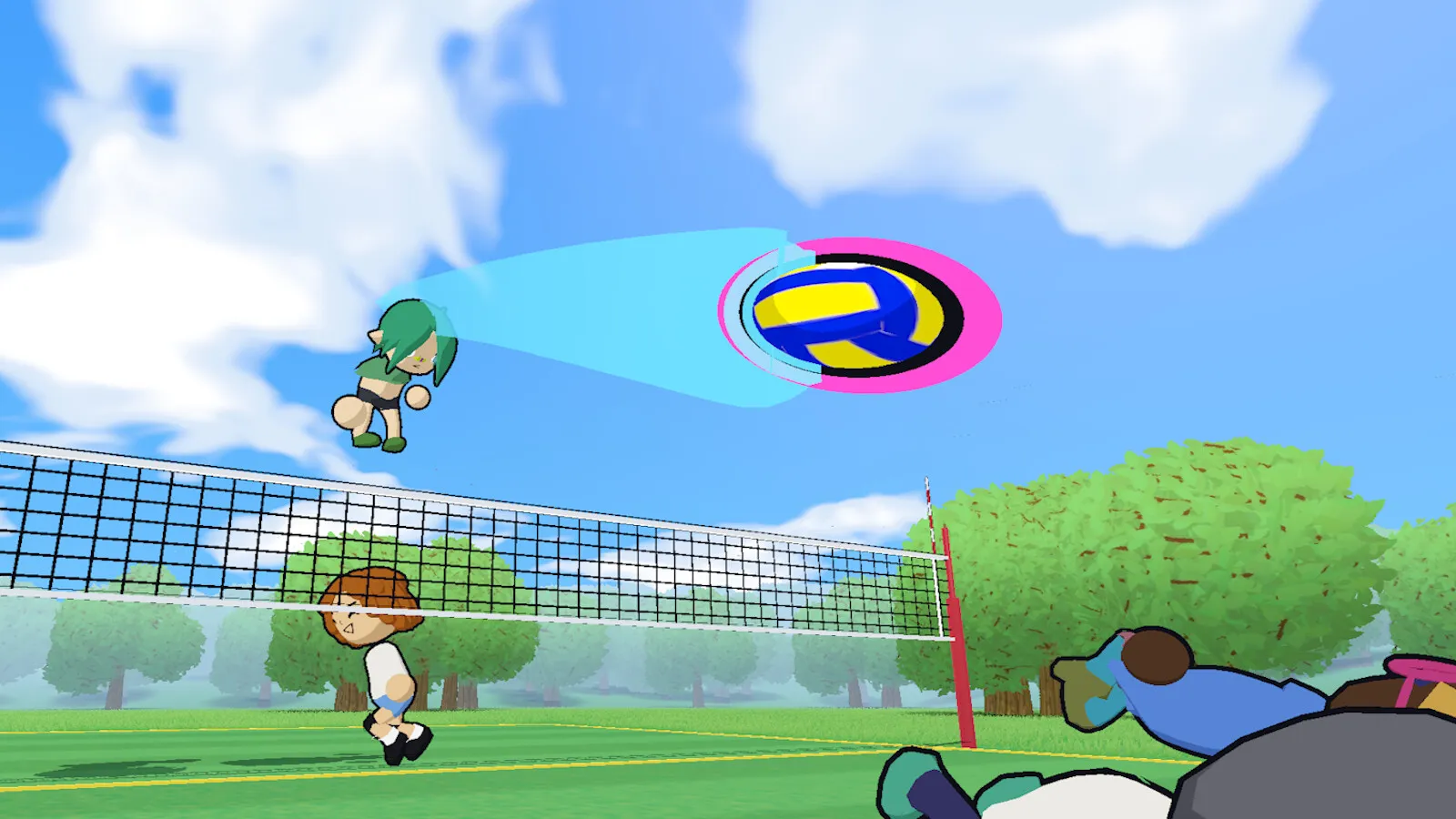
Get the ball in before you try to make it hard. A deep, safe serve that starts a rally is worth more than an ace attempt that misses.
The two-part motion
Every serve has two inputs: the toss and the contact. They are separate, and rushing either one is the root of most errors.
- Set your feet. Stand behind the end line, facing the court. You do not need a run-up for a standing serve.
- Toss the ball. The toss should go slightly in front of your hitting shoulder. A toss that is too far forward forces you to reach; too far back forces you to wait.
- Watch the ball. The cursor is your target, but your eyes should be on the ball until contact.
- Contact. Click at the top of the toss, with the cursor aimed at the zone you want to hit. The controls guide covers the input timing in more detail.
The timing window is forgiving once you stop mashing. If the toss is bad, let the ball drop and serve again. A reset is cheaper than a net serve.
Float serve: the default
The float serve is the staple for a reason. It has little spin, a flat trajectory, and a late wobble that makes the receiver's pass unpredictable. It is also the easiest serve to control.
To hit a float:
- Toss the ball slightly lower and in front.
- Contact it with a firm, short motion rather than a long swing.
- Aim deep, toward the end line, not at the middle of the court.
- Keep the cursor steady through contact. A moving cursor produces a moving serve.
The float is not a power serve. Its value is placement and movement, not speed. A float that lands on the end line is harder to pass than a fast serve that lands mid-court.
Spin serve: hold a direction
The community answer to "why can I aim outside the court?" is the key to spin: hold A, D, W, or S while you contact the ball. The direction adds curve, so a serve aimed outside the sideline can bend back in.
That opens up three useful shapes:
| Hold | Curve | Best target |
|---|---|---|
| A | Bends left | Left sideline, short zone |
| D | Bends right | Right sideline, deep corner |
| W | Bends forward/down | Deep middle, end line |
| S | Bends back/up | Short middle, service seam |
The exact curve depends on contact timing and the build, so treat the table as a starting point, not a fixed physics table. The important habit is to commit to a direction before contact; holding a direction after the ball leaves does nothing.
A curved serve is harder to control than a float. Learn the float first, then add one spin direction at a time.
Target zones that actually matter
A serve is a pass denial tool. The best target is the one that makes the receiver move farthest before the ball arrives.
Deep corner
The classic. It pushes the receiver to the back line and stretches the pass. If the receiver is slow, the ball lands untouched. If they get there, the pass is often high and off the net.
Short middle
A short serve forces the receiver to step forward and pass upward. It is especially effective against a team that stands deep by default. Mix it in after two deep serves to keep them honest.
The seam
The seam between two receivers is the highest-value target in a pick-up lobby. Two players can both watch the ball land, and neither takes it. Aim at the space, not at a player.
The weak passer
In a lobby with a clear weak link, serve at them repeatedly. It is not rude; it is the correct tactical choice. A team that cannot pass cannot attack.
Serve errors and how to fix them
| Error | Cause | Fix |
|---|---|---|
| Serve into the net | Contact too low or cursor too short | Aim deeper; contact at the top of the toss |
| Serve long | Too much power or a late contact | Reduce the swing; aim a step inside the line |
| Serve straight to the libero | Default aim at the middle | Pick a corner or a seam before the toss |
| Inconsistent toss | Rushing the motion | Slow down; reset a bad toss |
| Spin serve misses wide | Holding the direction too late | Commit before contact; aim inside the line |
The most common fix is not a new technique. It is a slower routine. A server who tosses the same way every time will outperform a server who tries a different trick every point.
Practice drill: 30 serves
Set a target in each zone and serve ten balls to each:
- Ten deep corners (five left, five right).
- Ten short middle.
- Ten seam serves, alternating sides.
Count only serves that land in. Then count how many produced a pass that the receiving team could not attack. The second number is the one that matters.
If you are practicing alone, serve at empty zones and watch the landing spot. If you have a partner, have them pass and count the quality of the pass.
Serving in different modes
- 1v1: the serve is a duel opener. A deep serve gives you time to recover; a short serve can catch an opponent who expects depth.
- 2v2: serve the seam. Two receivers, one ball, and a lot of confusion.
- 4v4 and up: serve the weakest passer and the seams. Do not try to ace a full team; try to force a bad first touch.
The game modes guide explains why the same serve has different value at different team sizes.
When to take risk
Take a risk when the score is in your favor and the opponent has just made a mistake. Do not take a risk on a must-win point. A safe serve that starts a rally is a better default than a low-percentage ace attempt.
The exception is a receiver who is clearly rattled. If someone has shanked two passes in a row, serve at them again, even if the safe target is elsewhere. Pressure compounds.
FAQ
How do I serve in just volleyball?
Toss, watch the ball, and click at the top of the toss with the cursor aimed at your target. The serve is a standing motion, not a run-up.
How do I do a float serve?
Contact the ball with a short, firm motion and little spin. Aim deep and keep the cursor steady.
How do I add spin to a serve?
Hold A, D, W, or S while you contact the ball. The direction curves the serve, so you can aim outside the court and bend it back in.
Why does my serve keep hitting the net?
You are contacting too low or aiming too short. Aim deeper and meet the ball at the top of the toss.
Further reading
Tested source: serve inputs cross-checked against the Steam store page, RPS hands-on, and the Steam forum thread on aiming outside the court.
More just volleyball Guides
Fast answers on the just volleyball release date, price, demo, crossplay, gamepad support, LAN, split-screen, system requirements, and launch status.
Every just volleyball team size explained, from the 1v1 duel to the full 6v6 court, with the best mode for beginners and the settings that change a lobby.
A plain-language just volleyball tutorial: the rally flow, the three-touch pattern, each position, and the fastest way to survive your first online match.
A step-by-step guide to playing just volleyball with friends online, on LAN, in split-screen, or via Steam Remote Play, plus fixes for common lobby problems.
How just volleyball multiplayer works across online play, LAN, split-screen, and co-op, including the server browser, lobby sizes, ping, and moderation.
The free public playtest opened on September 23, 2026 on a separate Steam app. Here is how it differed from the demo and whether it is still running.
The developer quoted a $7.99 base price for just volleyball with a 38% launch discount. Here is what is confirmed, what is not, and how regional pricing works.
The defensive half of just volleyball: how to receive a serve, set a hittable ball, position behind the block, and cover the court without wasting stamina.