
Just Volleyball Receive, Set, and Positioning
The defensive half of just volleyball: how to receive a serve, set a hittable ball, position behind the block, and cover the court without wasting stamina.
Attacks get the clips, but defence wins the rallies. A team that can receive a serve and set a hittable ball will beat a team with one big hitter and no backcourt. This guide covers the three defensive skills that hold a rally together: the receive, the set, and the position you take before either one happens.
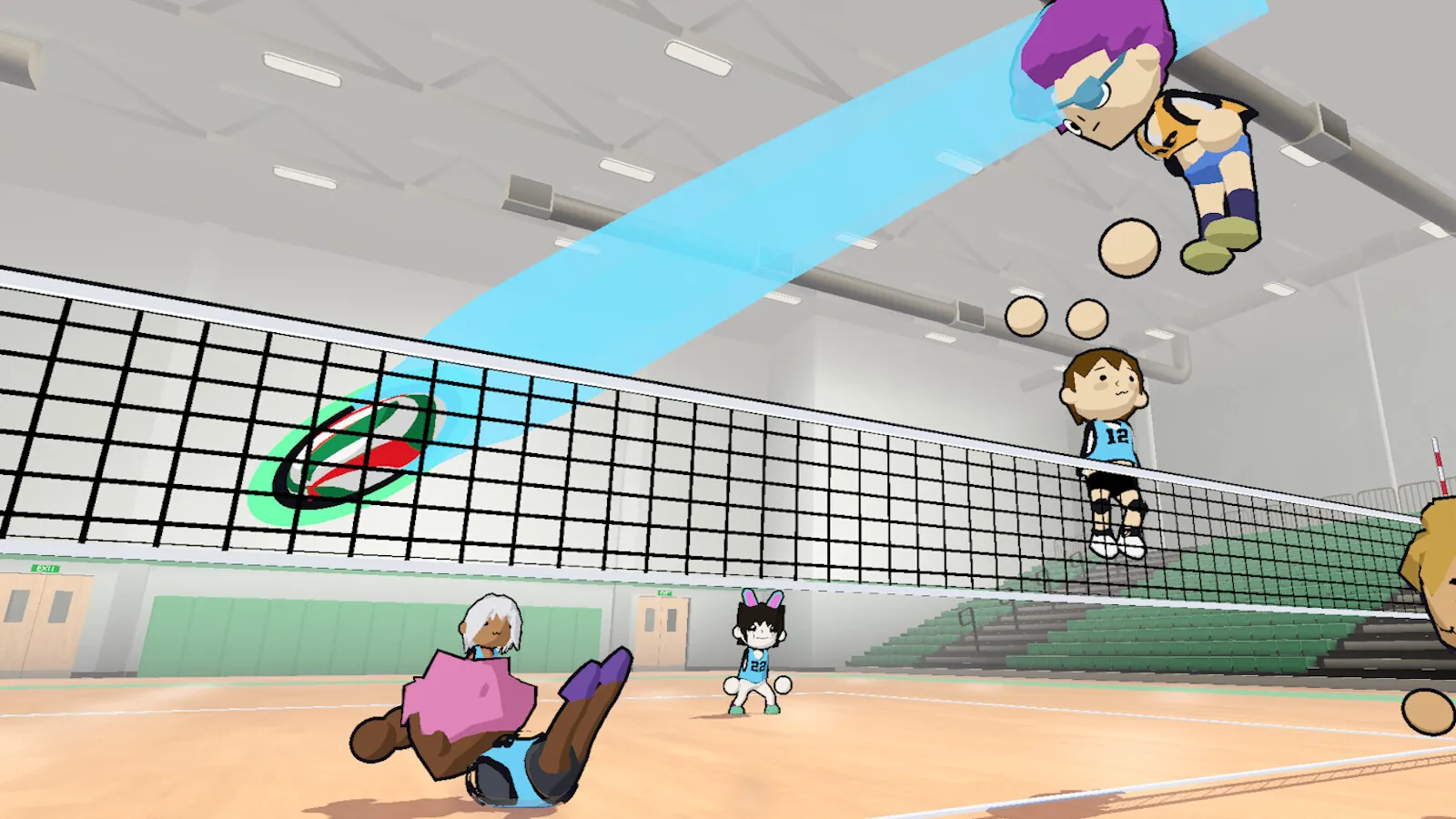
Your first job is to keep the ball alive. Your second job is to make the next contact easy. Neither job requires a hero play.
The receive: control, not power
A receive is the first contact after the opponent's serve or attack. It is a pass, not a hit. The goal is to send the ball to a teammate, usually the setter, with enough height and control that they can set.
Three habits separate a good receiver from a bad one:
- Move early. Take two steps before the ball crosses the net, not five after it lands.
- Stop before contact. Plant your feet, set the cursor, then click. Moving while passing adds error.
- Aim at a person. Put the cursor on your setter or teammate. Do not aim at empty court; empty court is where the opponent wants the ball.
A high, slow pass to the middle of your court is a good pass. A flat, fast pass that flies over the net is a gift.
Receiving a serve
Serves arrive faster than free balls, and they can curve. The receive starts with a read:
- Watch the server's contact, not the ball's flight.
- Move to the spot where the ball will land, not the spot where it is now.
- If the serve is short, step forward and pass upward.
- If the serve is deep, step back and let the ball come to you.
The most common error is reaching forward with the cursor instead of moving the body. The cursor aims the pass; the body gets you in range. If the ball is outside your reach, the pass will be weak no matter where the cursor is.
The dig and the dive
A dig is a receive of a hard-driven ball. You will not always have time to move your feet. The dive (right click on the ground) extends your reach, but it costs stamina and leaves you on the floor.
Use the dive when:
- The ball is about to hit the floor.
- You are the closest player.
- A teammate is already covering the next shot.
Do not use the dive:
- As a movement option between rallies.
- When a teammate is closer.
- When you still have time to take a step.
A dive that saves the ball is worth the stamina. A dive that misses is a point and a recovery problem.
The set: lead the hitter
The set is the second contact and the one that decides whether your team attacks or scrambles. Press E to set; hold it to charge. The charge affects the arc and distance.
The target is not the hitter's body. It is the space in front of the hitter, where their approach will meet the ball. A set that arrives early lets the hitter swing; a set that arrives late forces a desperation contact.
Three set types worth learning:
| Set | Height | Best for |
|---|---|---|
| High outside | High and slow | Beginner hitters, giving them time |
| Middle quick | Low and fast | A hitter who can time a quick approach |
| Back set | High, behind the setter | A right-side attacker or a decoy |
Do not overcomplicate the set. A high ball to the antenna is a good set at every level below competitive play. The spike guide explains what the hitter needs from you.
Positioning: the defensive shell
Positioning is where most points are lost before the ball is even hit. The shape depends on the mode, but the principles are the same.
Behind the block
Stand behind the block, not beside it. The block takes away one angle; you take away the other. If you stand beside the blocker, the deflection lands in the space you left.
Cover the line and the cross
In 4v4 and up, assign one defender to the line and one to the cross. The blocker seals the middle. Three bodies, three zones.
Watch the hitter's approach
A wide approach usually means a line shot. A sharp approach usually means cross. You do not need to be right every time; you need to be early enough to move.
Stay low and central
The middle of the court is the best default. A defender who starts central can reach both corners; a defender who starts in a corner can only reach one.
Rotation and switching
Just volleyball does not enforce a rigid rotation, but the court does. When a player moves from front row to back row, someone has to take the vacated space. The simplest system for a pick-up lobby:
- Front row: two blockers and a setter.
- Back row: two defenders and a server/receiver.
- After the serve: the back-row players shift to cover the block.
If your team does not rotate, the same player will be caught at the net on every rally. Call "switch" early, before the serve, not during the rally.
Stamina management
Dash and dive cost stamina, and stamina does not refill instantly. The best defenders spend it in bursts:
- Dash to close a gap, then plant.
- Dive only when the ball is about to land.
- Do not dash to a ball you could walk to.
- Save a little stamina for the transition after the block.
A defender with stamina in the last third of a rally wins more balls than a defender who spent it all in the first five seconds.
Communication
The receive is the contact most likely to cause a collision. Two players watching the same ball is a guaranteed point against you. Call "mine" early, and call it loud enough that the other player stops.
In a lobby without voice, use the quick chat keys and move decisively. A player who takes the ball with confidence is easier to read than two players who hesitate.
A defensive drill
Set up a bot or a friend to serve and attack. Play ten rallies with one rule: every first touch must go to the setter. Count how many rallies produce a hittable set.
Then add a block. The blocker seals one angle; you cover the other. Count how many blocked balls your team keeps alive.
The drill is simple because the skill is simple: get in position early, stop before contact, and aim at a person. The beginner guide builds this into a seven-day plan.
FAQ
How do I receive a serve in just volleyball?
Move into position early, stop, aim the cursor at your setter, and left click. A high pass to the middle is better than a flat pass over the net.
How do I set?
Press E and hold to charge, then release. Aim at the space in front of the hitter, not at their body.
Where should I stand on defence?
Behind the block, not beside it. Cover the line or the cross, and start central so you can reach both corners.
Should I dive for every ball?
No. Dive only when the ball is about to land and you are the closest player. Diving costs stamina and recovery time.
Further reading
Tested source: contact roles and control inputs cross-checked against the Steam store page and the demo-era community threads on the Steam forum.
More just volleyball Guides
Fast answers on the just volleyball release date, price, demo, crossplay, gamepad support, LAN, split-screen, system requirements, and launch status.
Every just volleyball team size explained, from the 1v1 duel to the full 6v6 court, with the best mode for beginners and the settings that change a lobby.
A plain-language just volleyball tutorial: the rally flow, the three-touch pattern, each position, and the fastest way to survive your first online match.
A step-by-step guide to playing just volleyball with friends online, on LAN, in split-screen, or via Steam Remote Play, plus fixes for common lobby problems.
How just volleyball multiplayer works across online play, LAN, split-screen, and co-op, including the server browser, lobby sizes, ping, and moderation.
The free public playtest opened on September 23, 2026 on a separate Steam app. Here is how it differed from the demo and whether it is still running.
The developer quoted a $7.99 base price for just volleyball with a 38% launch discount. Here is what is confirmed, what is not, and how regional pricing works.
Just volleyball still shows November 4 on Steam, but temkosoft says the launch will slip. Here is the current status and the realistic new window.